Table of Content
However, it’s a good idea to consult an appraiser or real estate professional before investing in any renovations you hope will increase your home’s value. Remember that economic conditions — and the normal dips and swings of the real estate market — can affect your home’s value no matter what you do. If the value of your home increases due to a renovation project, your LTV ratio could drop, depending on how much equity you tapped to cover the costs.

PNC's website is not upfront about information like interest rates and term lengths unless you input details about your home, which could make it harder to compare broadly across lenders. Additionally, the fixed-rate option requires a $100 fee each time you lock or unlock a rate. PNC offers HELOCs, mortgage refinancing products and mortgage products. Its products and services vary by location, so you'll need to input your ZIP code on the website to see the rates and terms available to you. If you qualify for the entire 1.375 percent discount on your interest rate, you’ll save a lot over the life of your loan.
Understanding LTV
Keeping the LTV ratio below 80% is generally advised to qualify for the lowest possible interest rate. If the ratio is above 80%, the borrower may be required to get private mortgage insurance . You can also decrease this ratio by making a larger down payment or searching for a more affordable house.

Some lenders, such as Arsenal Credit Union and Signature Federal Credit Union, offer 100% LTV home equity loans. Arsenal offers no-closing-cost loans, while Signature Federal offers closing costs savings of up to $1,000. Banking, mortgage and home equity products offered by Bank of America, N.A., and affiliated banks, Members FDIC and wholly owned subsidiaries of Bank of America Corporation.
How can I apply?
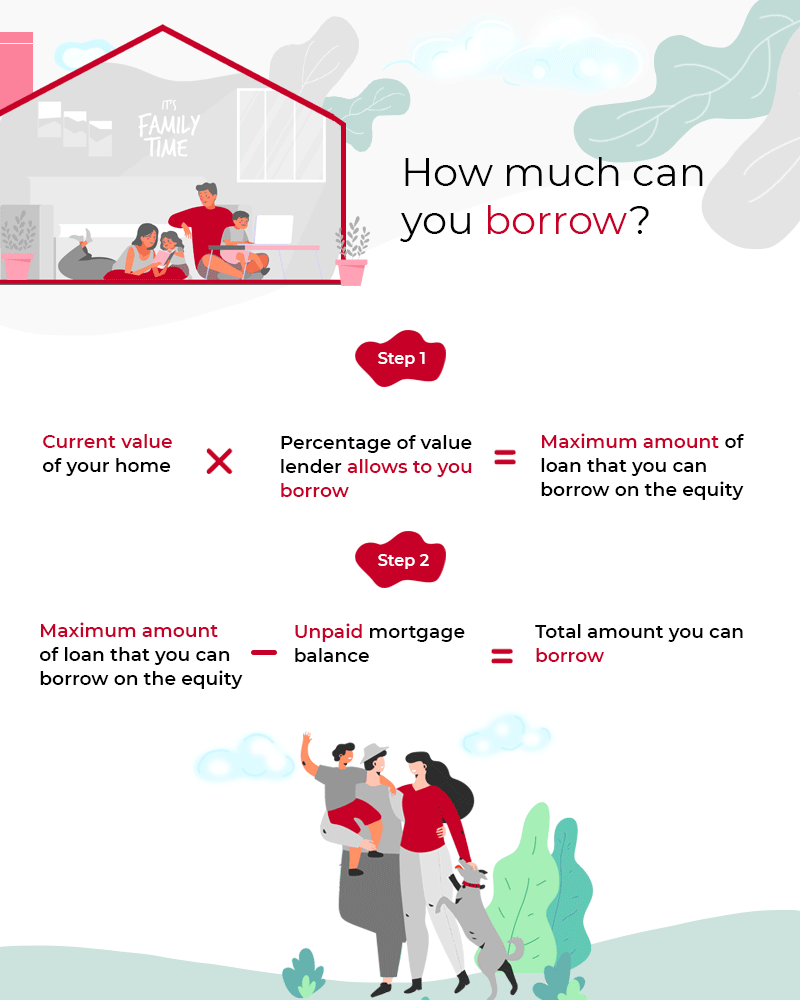
This includes your primary mortgage as well as any home equity loans or unpaid balances on home equity lines of credit. In a typical example, homeowner Caroline owes $140,000 on a mortgage for her home, which was recently appraised at $400,000. While you do not have to repay principle during an interest-only draw phase of a HELOC, you can usually do so without penalty. This not only reduces what you have to eventually repay when the draw period ends, but also allows borrowers to use a HELOC for cash-flow management, borrowing as needed and repaying when they can. This is helpful for people who have irregular incomes or expenses and are seeking to smooth out the peaks and valleys of their finances. All home equity loans and HELOCs are secured by the equity in your home – that is, you're using your home equity as collateral.

When it comes to a rental property, however, lenders typically require higher levels of equity for approval because it's a riskier loan for them. Home equity loans are usually best for people who need a lump sum right away and want a predictable monthly payment. Plus, at UW Credit Union there’s low or no closing costs on HELOCs or Home Equity Loans. When you apply for a loan, lenders will typically review your credit history and other financial factors like your debt-to-income ratio and credit scores. They’ll also probably consider your loan-to-value ratio to determine how risky your loan may be. Home equity loans and HELOCs use the equity you own in your home as collateral.
HELOC vs. cash-out refinance
Programs, rates, terms and conditions are subject to change without notice. You also can't be carrying too much debt – your total monthly debts, including your mortgage payments and all other loans, should not exceed 45 percent of your gross monthly income. To use an equity line of credit calculator, you feed in the current estimated value of your home, then the amount owed on your mortgage, and the loan-to-value ratio which your lender offers.
When shopping for a HELOC, look for a competitive interest rate, repayment terms that meet your needs and minimal fees. The top lenders listed below are selected based on factors such as APR, loan amounts, fees, credit requirements and broad availability. Unlike home equity loans, HELOCs are credit accounts, where a line of credit is established that allows you to borrow over time. HELOCs are more akin to a credit card account than to a loan, as you can borrow as many times as needed up to certain limit, and until a date when repayment starts. Your home equity and loan-to-value ratio are how lenders determine your eligibility for home equity loans, home equity lines of credit , cash-out refinancing and more.
Home equity line of credit (HELOC) rates for December 2022
Mortgage products are not offered directly on the Mortgageloan.com website and if you are connected to a lender through Mortgageloan.com, specific terms and conditions from that lender will apply. The 2008 recession and its aftermath brought LTV and CLTV ratios into the spotlight — and made lenders more stringent when it comes to requirements for home equity loans and HELOCs. That’s because many lenders ended up underwriting loans for homes that were underwater. When borrowers defaulted, secondary lenders were unable to recoup their money, as many foreclosures only recouped the lower value of the original loan.
That can be problematic for the lender because if you default on a loan, the lender might not be able to recoup its loss by selling your property. The LTV would be the loan amount of $160,000 divided by the appraised value of $200,000, which is 0.80, or 80%. The LTV ratio formula is fairly straightforward, as it only involves the loan amount and the value of the asset you’re buying. Loan-to-value ratios are used to measure how a loan amount compares to the asset it’s being used to purchase.
This may mean buying a smaller home or buying in a less-expensive area. Once you’ve gotten a loan, you can lower the LTV ratio by making loan payments, and the LTV will rise or fall based on your home’s changing value. You may find it hard to get approved for a loan that has a high LTV ratio.
Repayment periods are usually governed by a fixed rate, though variable rates can be used as well. Typically, the draw period is variable and then the repayment period moves to a fixed rate, set as a percentage over the prime rate. Check with your lender and the specific terms of your deal to be sure of how it’s handled. Some borrowers choose to refinance into a new HELOC at the end of the draw period. This may be to avoid the payment shock of the higher monthly payments required to repay both loan principle and ongoing interest charges, but may also be done to just to keep the line of credit open.
Alix is a staff writer for CNET Money where she focuses on real estate, housing and the mortgage industry. She previously reported on retirement and investing for Money.com and was a staff writer at Time magazine. She has written for various publications, such as Fortune, InStyle and Travel + Leisure, and she also worked in social media and digital production at NBC Nightly News with Lester Holt and NY1. She graduated from the Craig Newmark Graduate School of Journalism at CUNY and Villanova University.
With this loan, you borrow a fixed amount of money backed by the equity in your home and then pay it back with fixed monthly payments of principal and interest until it’s paid off. Unlike a line of credit, you can’t dip back into the loan after you’ve paid part of it down; you would have to refinance the loan before you can access new funds. While Discover® Home Loans does not currently offer FHA, VA, or other conventional mortgage products, a mortgage refinance is available for loan amounts from $35,000 to $300,000. This is available with zero origination fees, zero application fees, zero appraisal fees, and low, fixed rates. While some lenders offer a wide range of loan amounts, Figure caps its loans at $400,000 — though you may qualify for less, depending on your loan-to-value ratio and credit score. While home equity loans provide you with a lump sum amount that you’ll pay back in fixed installments over a predetermined period, a HELOC is a revolving line of credit.
Many HELOCs have an initial period of time — a draw period — when you can borrow from the account. After that, you might be able to renew the credit line but if not, you will probably have to start repaying the amount due — either the entire outstanding balance or through payments over time. HELOCs generally have variable interest rates and payments so the rates and payments can go up or down over time. Like credit cards, HELOCs typically have variable interest rates, meaning the rate you initially receive may rise or fall during your draw and repayment periods. However, some lenders have begun offering options to convert all or part of your variable-rate HELOC into afixed-rate HELOC, sometimes for an additional fee.


No comments:
Post a Comment